Campus-Produced Documentary Sheds Light on the Silvio O. Conte Wildlife Refuge
Written by Samuel Turgeon
Following USJ’s Earth Day festivities on April 21st, a campus-produced documentary was revealed in the Bruyette Auditorium. The documentary dealt with the Silvio O. Conte National Fish and Wildlife Refuge. The Conte Wildlife Refuge comprises nearly 40,000 acres of land and spreads across parts of Connecticut, Vermont, Massachusetts, and New Hampshire.
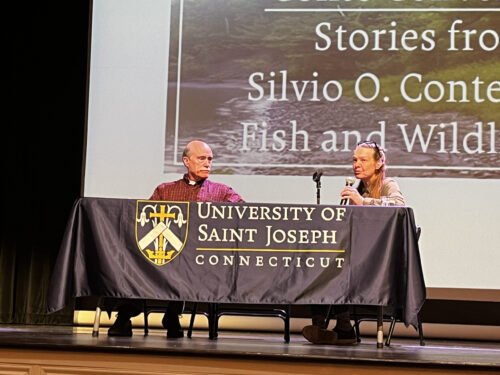
Prior to the premiere of the documentary, a brief panel was held in order to discuss watersheds and the value that they bring to a community. Watersheds are areas of land that drain water into a specific body of water. The panel consisted of two members: Carl Sampson and Mary Pelletier. Both of them have worked in order to protect and raise awareness about watersheds. Carl Sampson is the president of the Scantic River Watershed Association, while Mary Pelletier has worked to advocate for the Park River regional watershed. Both panelists discussed the positive impact that nature can have on an individual’s life and the positive memories that they have regarding their respective watersheds.
The documentary was roughly an hour long and contained interviews with a variety of different individuals. Both Carl Sampson and Mary Pelletier were featured heavily in the documentary, along with USJ’s Dr. Kirsten Martin. The documentary inspected the importance of the watershed from a variety of different angles, including the opinions of musicians and artists alongside scientists and activists.
The documentary was produced by USJ professors Dr. Kirsten Martin and Dr. Pablo Correa, as well as former USJ professor Dr. Joshua Anderson. Dr. Correa worked to edit the footage. A number of USJ students were also credited in the documentary, including News Nest writer Crista Fiala, who also helped to produce the film. (You can find some of her other work here!).
Following the premiere of the documentary, I emailed Dr. Martin and asked her whether or not there were any future plans for the film. She replied that she has been asked to show the documentary at a number of different venues, including at least one film festival. Dr. Martin’s ultimate goal is to have the film reside in the “Conte Corner” exhibit at the Springfield Museum. When asked about the significance of the documentary, Dr. Martin replied that it was: “A wonderful way to involve students in a project that will inform the public about an important location. The film also helps highlight some of the work that several groups within the refuge are doing.”
Featured Photograph: Samuel Turgeon