Learning About Science Communication with Milo Rossi
Trevor Stone Priesnitz
November 12, 2025
About one month ago today, I attended an event with an online science communicator whom I have been following on social media for the past few years. This internet personality, Milo Rossi, is a UMaine graduate who uses social media as a platform to educate his millions of followers on subjects such as archaeology, environmental science, and the dangers of misinformation. The event I attended was the second stop on Milo Rossi’s first tour, which was held on October 18th in the Mandell Jewish Community Center . I attended this event alongside my best friend who had never seen or even heard of Milo Rossi, and I appreciate my friend for trusting me this much considering he paid for his own ticket. When I arrived at the MJCC with my friend in tow, we were amazed by the incredibly long line that formed behind us. This event had fully sold out, and by my rough approximation there were about 140 people in attendance packed into the presentation hall.
So, why should you care about this event or this “Milo Rossi” guy? Firstly I would like to highlight the age of Milo Rossi, and how most of the people in attendance were (in appearance) mostly between the ages of 18-30. Milo Rossi is a Zoomer, like myself and most of the people attending. The work that folks like Milo Rossi and the many other professionals mentioned in his presentation highlighted the potential in the younger generation to combat the persistence of misinformation and delusion present in our world today. The presentation that Rossi has been touring around the Northeast with up until November 9th was on the subject of how to combat misinformation, as well as strategies he personally employs to do such a task.
Being familiar with Milo Rossi’s content, I was worried that this presentation would simply echo many of the points that he has made in his YouTube videos and other online content. I was pleasantly surprised by Rossi’s development of his professional process, as well as how much stronger he has grown as a public speaker and as a science communicator. His presentation followed the structure of: defining pseudoarchaeology, the actors present in the process, how people fall victim to it, and what we can do to stop it.
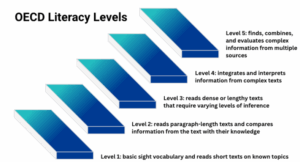
Here are some highlights from the presentation that I found compelling. Rossi claims that pseudosciences are appealing to the public because they can afford to be fun and entertaining because of their detachment from the scientific process. He points to recent events such as the “Giza Pyramid Pillars” hoax from earlier this year. Rossi carefully researched and presented the timeline of how this hoax was developed over such a short span of time, with it going from small publications to global virality in the span of roughly a week. The dangers of such hoaxes is that they fuel pipelines into more extreme ideas outside of just arguing about pillars under the pyramids or alien interference. Rossi brought evidence of connections between extreme ideas such as Neo-Nazism to some of these recent hoaxes, and pointed out how this is not a new pattern. The reason why so many people fall for these hoaxes, Rossi argues, is due to a lack of scientific literacy among the American population. Rossi cites the OECD literacy level system to categorize the US population of adults. He pointed out how as of a 2023 survey, approximately 29% of US adults scored a 2 or lower, and 28% scored a 1 or lower.
You may be thinking: “Wow, this kind of sucks real bad! What can we even do about this?” And to you my strawman reader, I will answer your question with what Rossi presented as some possible solutions. Rossi’s profession of science communication is how he has personally chosen to combat misinformation. This occupation involves the intake and digestion of very inaccessible scientific information (i.e. lab reports, scientific publications, etc.) and makes them palatable for the general public. So what about people like you and me who don’t have millions of followers? Rossi highlighted the importance of those in academia to try to act more welcoming to the general public, as there is an image of reclusively and prestige associated with academia as a sphere. This can be as simple as making a social media page and sharing what you are researching, whether it be to science communicators or to attempt science communication yourself. For those outside of academia, Rossi implored for those people to create whatever they could with the goal of education and opening doors to science spaces in mind.
At the end of the presentation, Rossi opened the floor to Q&A. The question that I brought forth was about how independent journalism could stay viable in a world where people either cannot afford to pay for memberships or are distrustful of larger publications. Rossi answered in multiple parts, beginning with emphasizing how important social media is for the ability of individuals to have their voices and opinions heard. This can be difficult to navigate, however, as misinformation can also be spread under the guise of independent journalism. Rossi also later answered a question from another audience member on the viability of journalism as a profession. Rossi pointed out that professional journalists do need to be compensated for the research work that they do, but the current financial model that they must operate within is a systemic issue.
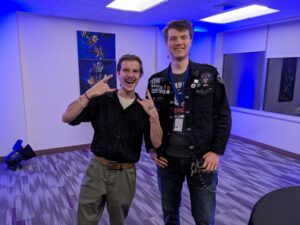
I left the presentation in a hopeful mood, along with a cool t-shirt, some signatures, and even some words exchanged with Rossi himself. I expressed my gratitude for the work that he has done, as well as how he has impacted other generations as well (shoutout to my Nana, who is a fellow fan of Rossi). I implore anyone reading this article to check out Rossi’s work, as he is able to make education entertaining and accessible. In a time where hope and education is needed more than ever, remember to stay curious and question everything.
Milo Rossi’s socials:
https://www.youtube.com/@miniminuteman773
(Instagram) @miniminuteman