
Women’s Leadership Center – Women Leaders in the Arts Event
By: V Stone Priesnitz
On February 17th I attended a panel that our school’s Women’s Leadership Center (WLC) formed to discuss roles of leadership in the arts related to gender. I knew little about the WLC and the event, and I was curious how large of an event this was going to be. I attended alongside fellow “News-Nester” Nova Brown, who was vital in helping me to record the event. Our first impression was a pleasant shock at how large the event was, with seemingly dozens of attendees checking in at a table by the entrance of the Hoffman Auditorium. Hors d’oeuvres were served before we took our seats. There was quite a crowd of both students and patrons of the arts mingling in the Bruyette lobby varying in age and sex (or gender).
I wish I had done a general head count, but if the event had not been in the Hoffman Auditorium, any other event room on campus would have been overcrowded. We waited for quite some time for the panel to begin, and that was really my only point of contention with the event. I was expecting the panel to begin shortly after five p.m. as it was advertised, however, it began closer to almost quarter of six. This ended up cutting time out of the audience Q & A session at the end, which was slightly disappointing as a reporter.
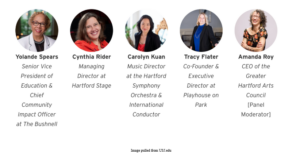
Once the discussion got rolling, it was fantastic. While everyone contributed greatly to the discussion, I was especially taken by Spears’ and Kuan’s contributions. I would like to highlight a few points of interest for me.
The first question Amanda Roy —the moderator— presented the panelists with was the topic of how they got themselves into leadership roles in the arts. Ms. Spears’ response was captivating, with her relaying her experience growing up during the Jim Crow years and finding leadership. She stated: “Leadership was not part of my vision, survival was.” Spears described her career in stages, highlighting her experience in school as part of the theater all the way up to her use of leadership in corporate settings. I found her story of how she encouraged fellow women working at Traveler’s to spearhead change to benefit everyone inspiring. Kuan’s response to Roy’s question was very interesting as well, as Kuan came at it from a musician’s perspective. Kuan compared how she applied the American methods of conducting to leadership, and how she believed that the Chinese method of conducting would not have worked for her, as she saw it as being too hard on the orchestra. Kuan also discussed how it was difficult initially establishing herself as the leader, and how she had to learn to be tough at the right times and to recognize who specifically she needed to lead to make sure all the rest would follow.
Roy later posited the topic of how the arts have been affected by the current landscape both politically and socially. Initially, Spears joked about how the panelists had made a pact to turn a question like this back at the moderator if it were to be asked . Generally speaking, the responses had a lot of overlap. Their primary concerns in the current world for the arts were all to do with obtaining necessary funding and attendance in order to better serve the community. There were many anxieties about getting people back into the community after COVID-19, as quarantine made people comfortable staying at home. Efforts are and have been being made by organizations such as those staffed by the panelists to make participating in the art scene more accessible and fun. An example of this was making seating more comfortable in theaters, providing art that is more diverse and pertinent to modern issues, and making sure that the public can financially access these arts. Creating a more financially accessible way to interact with the arts resonated with me the most as many people unfortunately face financial gatekeeping from the arts unfairly. It was reassuring to know that this is a concern for organizations in the area, and one of the solutions recognized in the panel was how the Hartford Public Library provides free tickets to the Hartford Stage to checkout for the city’s residents.
Unfortunately I cannot fit everything into a reasonably-sized article, so I hope that this leads some of you all to look into the women who attended this panel and shared their wisdom and experiences. Everyone who presented at the event contributed greatly to the discussion, and I implore you all to reach out to their places of employment and give them support in any way that you can. The part of this panel that made me the most excited was seeing all that is being done to make the arts more accessible to everyone. Because of this, I have strengthened hopes in people putting aside their phones and computers in favor of some in-person enrichment. A big takeaway from this panel for me was: when everything seems chaotic and scattered, one of the best things you can do is find community, and art is there for that purpose.