
Tenebris Somnia Brings Retro Horror to Life
By: Viktor Orzolek
It’s way past Halloween, but there is always time to experience a thriller that blends pixel graphics with live action.
Andrés Borghi, who serves as the writer and film director, and programmer Tobías Rusjan developed the survival horror game Tenebris Somnia in collaboration with Saibot Studios and an executive producer from Airdorf Games, the creator of Faith: The Unholy Trinity. New Blood Interactive, which has also published popular retro-style titles like ULTRAKILL, published the game. Its main focus pairs 2D, 16-bit gameplay with live-action cutscenes. The game is available on Steam, Nintendo Switch, PS5 and Xbox Series X/S.
Julia, the main character, played in live-action by Klara Kovacic
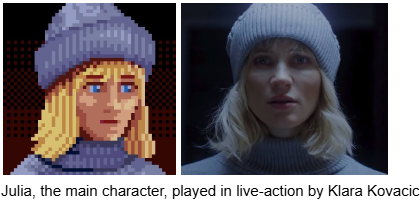
The minimalist aesthetic of the gameplay and overall direction stands out immediately. Both the controls and the atmosphere evoke classic survival horror games like Resident Evil (1996) or Silent Hill (1999). Even with 16-bit graphics, the developers keep the mechanics straightforward, featuring a streamlined inventory and crafting menu. Players can also examine objects in the environment while Julia comments on them — a staple of the genre. Weapons range from random items she picks up, like a wrench, to a prop gun that somehow functions like the real thing.
Better yet, Tenebris Somnia refuses to hold the player’s hand. Progressing requires interacting with the environment and reading scattered notes for clues. This design encourages exploration while uncovering more of the story. For example, players need iron as an ingredient to make a solution that dissolves wax blocking a door. A book in the kitchen mentions, “Iron is essential for the formation of red blood cells,” dropping a subtle hint and leaving the rest for players to figure out.
Sanguis, an ally, played by Esteban Prol
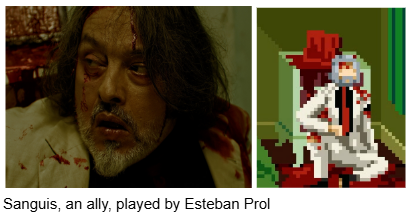
Blending retro graphics with live-action cutscenes is a bold choice that still preserves immersion. These scenes signal that something is about to happen or that a particular moment carries weight. Because there are no audible voice lines — all dialogue remains text-based — players stay firmly inside the characters’ perspectives. A crew of more than 30 people spent four years filming and developing the project, making it a shame that bloated AAA studios routinely release $70 games that fail to meet the same standard. At a modest $25, Tenebris Somnia easily lives up to the hype.
Fittingly, the Airdorf Games YouTube account released a short proving that the team did not use any generative AI in developing the game. It is wild that creators now need to provide receipts just to prove their work is human-made.
Tenebris Somnia brings together old-school survival horror and live-action filmmaking in a way that feels unusual without losing sight of what makes the genre enjoyable. Its puzzles reward curiosity, its presentation keeps the experience engaging and its commitment to practical effects gives the horror a tangible quality. For players who miss classic survival horror or simply want something different from the usual release, this nightmare is worth stepping into.