
Exploring Biography and Fiction at the Agora Series
By: Kira Dunphy
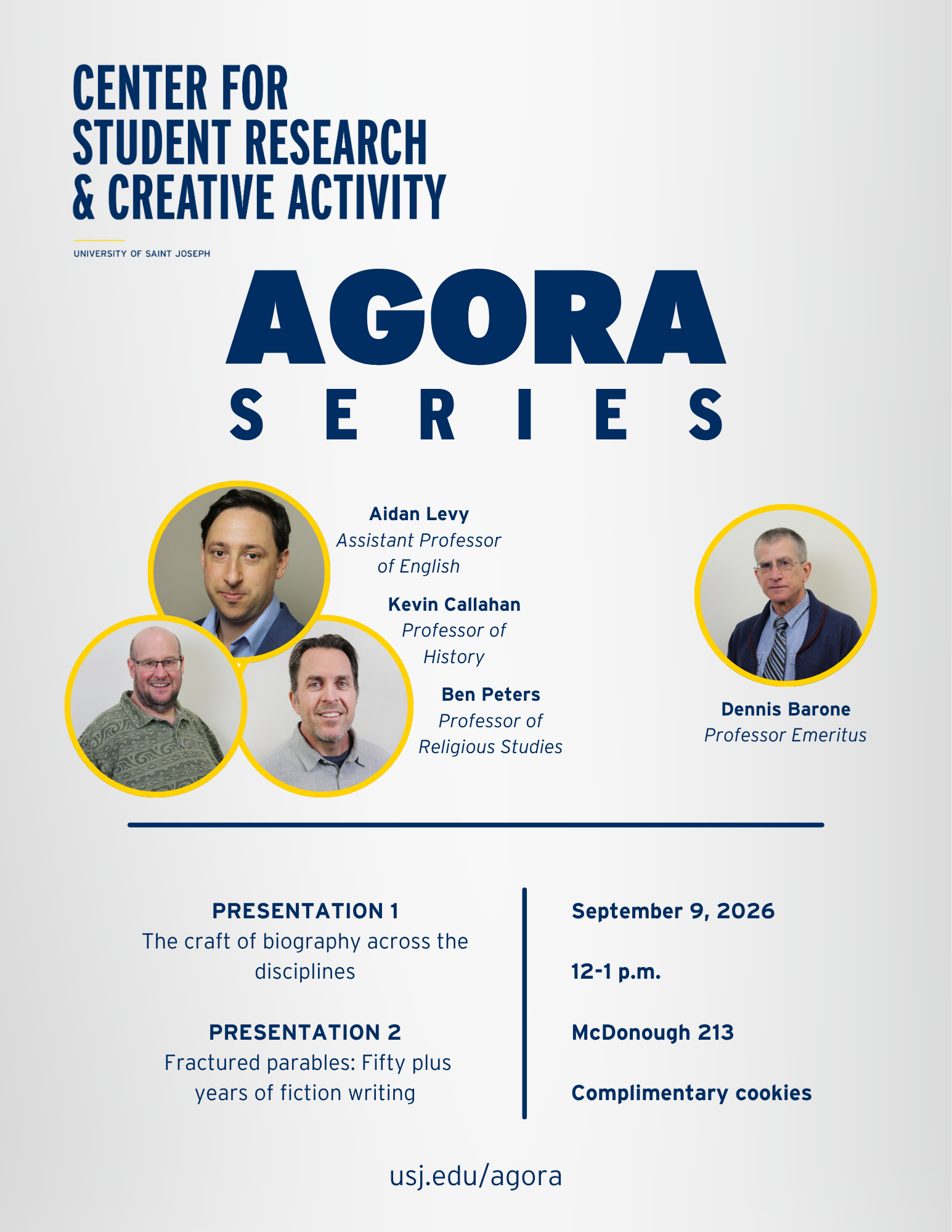
USJ hosted its first Agora Series of the semester on Sept. 9, bringing together four members of the humanities faculty to discuss the ways writers uncover stories, conduct research, and make sense of the people and worlds they write about. The event featured two presentations, The Craft of Biography Across the Disciplines, presented by Dr. Aidan Levy, Dr. Benjamin T. Peters, and Dr. Kevin J. Callahan, and Fractured Parables: Fifty Plus Years of Fiction Writing, presented by Dr. Dennis Barone.
The first presentation, The Craft of Biography Across the Disciplines, focused on the challenges of reconstructing another person’s life. Levy, Peters, and Callahan approached biography from different disciplinary perspectives, discussing archival research, interviews, primary sources, and the decisions involved in determining what parts of a person’s life to tell.
Levy, whose biography Saxophone Colossus: The Life and Music of Sonny Rollins won the American Book Award in 2023, described biography as a process of “demythologizing” public figures. Rather than simply repeating the myths surrounding famous people, biographers can use research to reveal the complicated human being underneath.
Levy also discussed David Maraniss’ “four legs of the table” approach to biographical research: “go there, find the documents, interview as many people as possible, and look for what is not there.” He illustrated the method through his research on Rollins, which included archival collections, oral histories, personal interviews, letters and visits to locations connected to the musician.
Peters, author of the biography Catholic Pacifist: The Long and Lonely Quest of Gordon Zahn, discussed his own experience writing biographies and the importance of primary sources, joking that “you can’t be a good historian unless you like reading dead people’s mail.” He also raised questions about how future historians will reconstruct our lives when so much of our communication exists digitally, including whether historians a hundred years from now will be able to access something as ordinary as our emails.
Callahan approached biography through the lens of transnational history, discussing his research on Austrian socialist Victor Adler. His work has taken him through European archives and across multiple languages as he traces connections between political movements. One particularly memorable discovery was a 1914 train ticket connected to Vladimir Lenin, demonstrating how a seemingly small archival document can connect to a much larger historical story.
The second presentation, Fractured Parables: Fifty Plus Years of Fiction Writing, shifted the focus from biographical research to the creative process of writing fiction. Barone, professor emeritus of English and a published poet, discussed his decades of experience as a writer and shared stories from throughout his career. He also reflected on his interviews with writers and his interest in potentially writing a biography of author Gilbert Sorrentino.
Barone read two of his own stories, Modern Aesthetics, from around 1975, and Destiny, from 2025. The selections, written roughly 50 years apart, offered a glimpse into Barone’s long career in fiction writing and the development of his work over time. Both stories are included in his collection Stage Fright: Fifty-Six Stories.
Although the two presentations approached writing from different directions, both emphasized the importance of looking closely at the stories people leave behind. Through archives, interviews, historical documents and fiction, the presentations demonstrated the many ways writers and scholars can explore the complexities of human lives.
Stay tuned for more Agora Series presentations throughout the semester!